PAO Open Space at PyCon JP 2026: One Year In, and What Comes Next
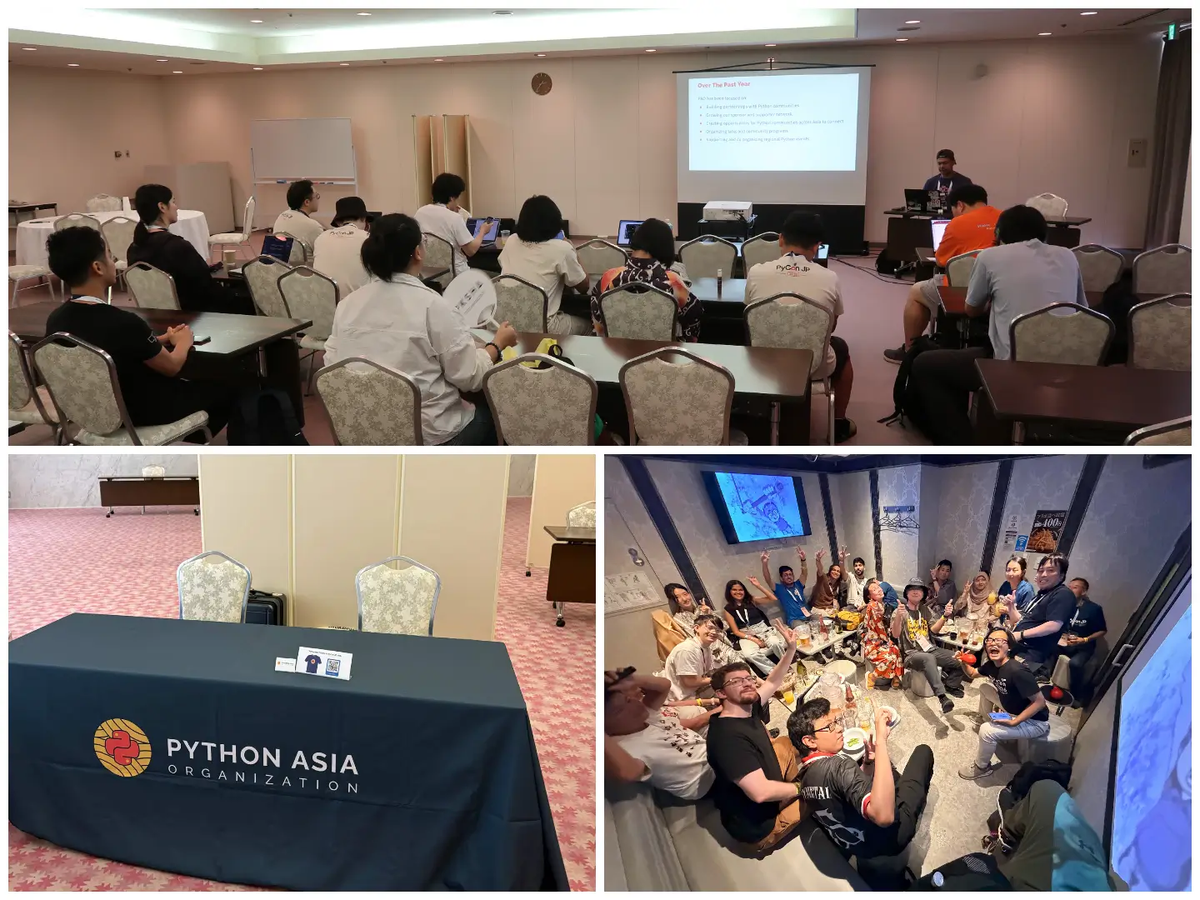
On the afternoon of the second day (Aug 22) at PyCon JP 2026 in Hiroshima, from 14:30 to 15:00, about thirteen of us sat down for the Python Asia Organization open space. Most came from East and Southeast Asian communities — Japan, the Philippines, Indonesia, and others — and three of them were attending a PAO open space for the first time. Manabu Terada and I managed the session.
We did not spend time explaining what PAO is. We did that last year. Instead, the open space had one job: share what we have done, and what we plan to do, and then let the room push back on the parts that matter to them. The pushback came fast, and it was worth having.
What We Have Been Doing
Over the past year, PAO's work has concentrated on five things:
- Building partnerships with the communities of the region, rather than operating next to them.
- Growing our sponsor and supporter network, so that the infrastructure cost of the regional conference does not fall on any single community.
- Creating more opportunities for communities across Asia to connect with one another.
- Organizing talks and community programs, including our online Charity Talks.
- Supporting and co-organizing the regional Python conference, which in 2026 ran under the PythonAsia name.
The support we have gotten from the community along the way has been humbling, and I want to thank everyone in the room for it publicly.
Sponsors and Supporters
PAO currently has four corporate sponsors: HENNGE and Python ED as Starter Gold sponsors, BeProud as Gold sponsor, and Python PH — the community friends who host us and who this year also sponsored the conference — as Silver sponsor. You can see the full list on our sponsors page.
Beyond corporate support, we have 19 individual sponsors contributing through GitHub Sponsors. On the community side, we have 440 people on our community mailing list and 292 email addresses on our job board. The numbers are small. They are also, in a quiet way, the proof that the organization is being used — every sponsor we present to a company comes with a real list of people in Asia who will see it.
The Highlight: PythonAsia 2026
The single biggest milestone of the past year is that we held our first regional conference under the PythonAsia brand: PythonAsia 2026 in Manila, March 21–23, co-organized with Python Philippines. This is the same conference Freilla Mae Espinola announced during her closing keynote at PyCon Singapore 2026, where she also shared the origin story of PAO itself.
This matters because it is the model we are trying to achieve. We have many strong communities across the region. When we collaborate, we can produce something none of us can produce alone. And because the structure that we have such as the brand, IP, sponsor pipeline, infrastructure and support network now lives in PAO, the same collaboration can be replicated by any community at any time, without rebuilding it from scratch. Manila helped us prove that collaboration can work. That is the point.
Two community programs also deserve a mention. Our Charity Talks run twice a year (H1 and H2), online and open to the whole region, featuring speakers who mostly contribute technically to the Python ecosystem. And our newest initiative, Python Across Asia, has just launched its first episode: A community-focused series introducing organizers, their plans, and their upcoming events. Episode 2 goes out on October 3; mark your calendars.
The Discussion: The Budget and Sponsorship Model
This part had the longest discussion and interest during the Open Space.
When we organized PythonAsia 2026 with Python Philippines, we worked out this arrangement: both sides brought their own sponsors: PAO went after international sponsors while Python PH after local ones and we combined the sponsorship income into one budget. We agreed that whatever was left over after expenses was split 50/50 between PAO and the host community. On top of that, Python PH paid PAO a EUR3,000 brand-use fee at the start, with a clause that the money is returned if PAO did not hit an agreed revenue target.
I want to be precise about the scope: that model was for PythonAsia 2026 with Python PH specifically. It is not a template we apply to every community. Communities in different places have different commitments and different economic strengths, and what is workable in Manila may not be workable in Seoul, Taipei, or Kuala Lumpur.
We had quite a few questions during the Open Space. Questions from the discussion:
- Is the 50/50 split because you pay for the brand, or because we work together to find sponsors? If it is the brand, splitting feels arbitrary. If it is joint sponsorship work, it makes sense.
- A sponsor may want to support a specific conference — "I have been sponsoring PyCon Taiwan for ten years, I just want to sponsor the regional conference next year" — how do we distinguish income that should be shared from income that belongs to the local event?
- Local sponsors can claim a tax deduction when they give to a local entity. Routing everything through an Estonian nonprofit changes that reality for them.
My response, and PAO's position, is the following. The ideal end state that PAO wants to achieve is similar to the model EuroPython uses — an RFP-style process where PAO holds all sponsors for the regional conference, sets the budget, and tells the host community: here is the budget, is it enough for your logistics and program, if not tell us how much more you need. In that model, the local community never has to think about sponsorship. They focus on the program, the logistics and the venue, and PAO carries the structural cost.
We are not there yet. We are a few years in. So the middle-ground model — combined sponsorship income with a split on the excess — is how we sustain the pipeline until we get there. I told the room: if you forget everything else from today except one thing about money, remember that this is still an open discussion. We will keep working through the tax and entity questions as we bring the model to new communities.
What Comes Next
For the coming year, the focus is on regional connection and presence:
- Deeper connections between members and communities, so people know one another beyond conference days.
- More community programs, including more space for communities to showcase themselves in Python Across Asia.
- More presence across Asia, with a PAO community booth at community events where we can be there.
- PythonAsia 2027 in Singapore, in June, co-hosted with the Singapore Python community. The offer came to us in Manila: one of the Singapore leads told us they want to bring the regional conference home. If your community is reading this and thinking we could host, talk to us first — do not worry yet about whether you can pull it off.
- A host-selection process to match. We are not using an RFP model for host selection yet. Based on the EuroPython experience, moving to that kind of process by 2028 or 2029 is the direction, and the room agreed community involvement in that process matters.
- Two more events this year. Our next online Charity Talk is on November 7. And, as an announcement we will make properly at today's closing ceremony: a special collaboration event between PAO and PyCon Tokyo on December 12, with keynotes and multiple tracks — and we are actively looking for volunteers and sponsors to make it work.
A Call to Action
Three people had never joined a PAO open space before today, and that is the exact goal: this is a room with a low door, and you are allowed in.
If you take one thing from the open space, make it this:
- The PSF board election opens September 1. Our region has candidates on the ballot this year, including Calvin Tsang from Hong Kong, who gave a short address at today's session, and Kalyan Prasad from India. You can read their full profiles and what they are running on in our earlier article about the PSF board nominees. If you can vote, vote; if you do not know how, ask someone in the room who has done it before.
- Join our mailing list if you are not on it. It is the minimum support we ask for, and every address makes our sponsor proposals stronger.
- Support us if you can. From EUR1 onward, you can support PAO through GitHub Sponsors. If you have time for Discord, join us and say hi. If you have neither, sharing what we do with your community counts.
PAO is small, young, and run by the same volunteers you already know. It exists so that when the next community wants to host the regional conference, they inherit a working framework instead of a blank page.
If you want to watch, follow, or join in, here is where we are:
Thank you to the thirteen of you who stayed for the whole hour, and to the three of you who walked in for the first time. The door is now open.