PyCon US 2026 Report Meetup: What Five Speakers Brought Back to Tokyo
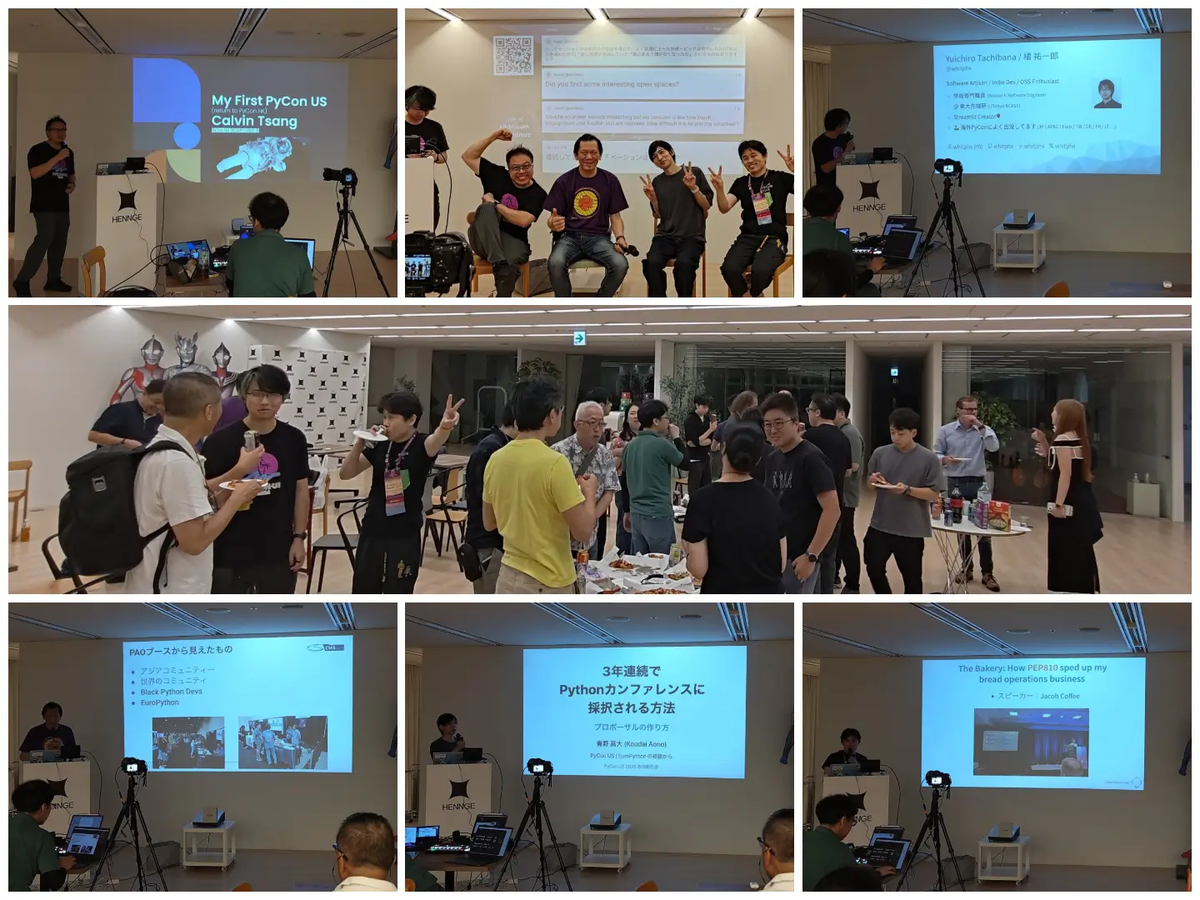
Yesterday I attended the PyCon US 2026 report meetup at HENNGE's offices in Shibuya, Tokyo. The event was organized as a hybrid gathering — about twenty of us in the room, with others joining over Zoom — and it did exactly what a good report meetup should do: it made the people who were not in Long Beach feel like they had been there.
First, the thank-yous. HENNGE hosted us in their eleventh-floor event space. The room handled the crowd, the projector, and the pizza without breaking a sweat. Thank you to the team there for opening the space to the community. The event was organized by the PyCon JP Association, who made the free onsite attendance (and the free beer) possible.
The format was straightforward: five short talks of roughly ten minutes each, followed by a panel discussion and a networking session. Each speaker had a different lens on PyCon US, which ran from May 13 to 19 in Long Beach, California. Between them, they covered what it takes to get accepted as a speaker, what is worth listening to, what it feels like to attend for the first time, and how to enjoy the conference without treating it like a job.
The PAO Perspective: Manabu Terada
Because this is pythonasia.org, I want to start with Manabu Terada, who is a Founder and Board member of the Python Asia Organization as well as a PSF Fellow. Manabu gave the first talk of the evening, titled "また来年も行きたくなったPyCon US 〜PAOブースとカメラ越しに見たコミュニティ〜" — roughly, "I Want to Go Back Next Year: PyCon US, the PAO Booth, and Community Through the Lens."
This was Manabu's sixth PyCon US. He spoke about two things in particular.
First, the Python Asia Organization booth in the community hall. Manabu has helped run the PAO booth for several years now, and he described it as a place where people interested in Asian Python communities can stop by, where attendees from Asia can find a familiar face, and where conversations with other regional communities — EuroPython, Black Python Devs — happen naturally. His slide listed the neighboring booths side by side, making the point visually: PAO is not on its own; it is part of a wider community ecosystem.
He noted that being there every year gives him a longitudinal view: he can see which communities are growing, which are struggling, and how the global Python landscape shifts. "Our community exists inside the larger world Python community," he said. "That sense is something I did not have before, and it matters."
Second, his camera. Manabu now travels to PyCon US with serious photography gear — a compact camera and a DSLR — and he uses it to document keynotes, speakers on stage, and friends in the community. These photographs do not just sit on a hard drive. They get used as profile pictures, report illustrations, and community records. He mentioned, with some amusement, that a photo he took last year was used as someone's avatar — until that person replaced it with a newer photo from this year's conference. The point he was making is that documentation is a form of contribution, and that the memories matter as much as the technical content.
Manabu also touched on two observations that stuck with him from this year's event. One was that AI adoption in programming looked, on the ground, not so different from what he sees in Japan. The tools are the same; the workflows are converging. The other was the difficulty facing junior engineers in the US job market — a conversation he heard repeatedly, and one that made him appreciate the relative stability of the Japanese technology scene.
His closing line was simple: "Sixth PyCon US. The meaning of my participation has shifted from watching, to connecting, to recording, to thinking about what comes next."
How to Get Three Consecutive Acceptances: Takahiro Aono
Takahiro Aono (koxudaxi) spoke about a topic many aspiring international speakers want to understand: how to get your PyCon US proposal accepted. He has done it three years running, and also speaks regularly at EuroPython. His talk was methodical.
He broke his approach into three questions he asks himself for every proposal: Why this topic now? Why am I the person to speak about it? And what will the audience take home?
Takahiro's subject is Python typing, and he has built a clear narrative arc across his three accepted talks: decorators and types in 2024, CI/CD and maintenance in 2025, and this year, how to express external data access — REST APIs, queues — with Python's type system. The key, he said, is to anchor the talk in a real problem you have solved, to tie it to recently released language features, and to keep the scope narrow enough that every slide delivers one actionable idea.
He also made a point that matters for any regional speaker aiming for an international stage: focus on the standard library. "Third-party libraries come and go," he said. "If you build your talk around the standard library, the audience is larger and the shelf life is longer."
The Curated Highlights: Takanori Suzuki
Takanori Suzuki, Representative Director of the PyCon JP Association, took a different approach. Rather than summarizing his own experience, he curated the talks he found most interesting. His selections give a good snapshot of what was actually being discussed at PyCon US this year.
His list included:
- Lazy imports (Python 3.14), with benchmark numbers showing real speedups
- Free-threaded Python, presented by Steering Council member Thomas Wouters, including the history of failed parallelization attempts in CPython
- Tachyon, the new sampling profiler coming in Python 3.15
- The PSF Security Engineers' annual update on PyPI threats and the new PSRT (Python Security Response Team)
- Steering Council panel, covering Python 3.15 features and the new Packaging Council
Takanori also mentioned that this year saw the introduction of dedicated AI and Security tracks — a notable structural shift for the conference.
A First-Timer's View: Calvin Tsang
Calvin Tsang, Chair of PyCon Hong Kong 2026, gave what he called an organizer's view of a first-timer's experience. He looked at PyCon US through the lens of someone who is currently planning a conference, and he focused on the logistics and facilities: the interpretation setup, the accessibility features like live transcription on a second screen, the open spaces, the sponsor booths that double as presentation venues, and the way the schedule balances main tracks with poster sessions, workshops, and lightning talks.
Calvin's presence was a reminder of why these report meetups matter. He is not from Japan; he is from Hong Kong, and he was in the room because the regional Python community is small enough that knowledge flows across borders easily. What works at PyCon US might inform what works at PyCon HK.
The Low-Pressure Approach: Yuichiro Tachibana
Yuichiro Tachibana (whitphx) closed the first half with a deliberately relaxed take. He went to PyCon US this year without a speaking slot, without a booth, and without a work agenda. He attended sprints, visited sponsor booths for projects he contributes to, went to unofficial meetups, and even ducked out of a sprint to visit the Queen Mary with friends.
His message was practical: the conference is large enough that you do not need to optimize every hour. If you treat it like a sightseeing trip with a conference attached, you still come away with connections, ideas, and momentum. He also had concrete advice for future attendees: apply for the travel grant, bring a jacket because the venue is cold, and consider Zip Air or Airbnb to keep costs down.
Panel Discussion and What Stuck
After a break, the five speakers gathered for a panel moderated by Ryuki Suzuki. The audience submitted questions via Slido, and a few themes kept coming up.
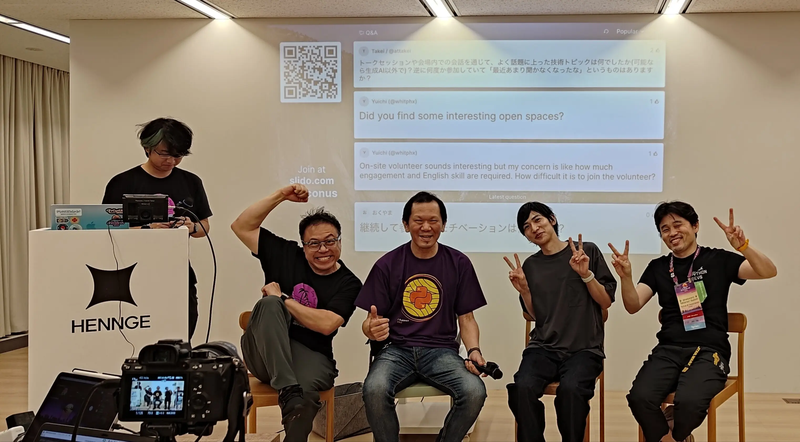
On costs: The rough consensus was that a week-long trip to PyCon US costs around 300,000 JPY without frills. Speakers who receive travel grants can cover most of this, but food and incidental expenses add up. Several panelists recommended Airbnb and budget airlines for independent travelers.
On motivation: Why keep going back? The answer, across the panel, was the people. Manabu put it plainly: "You meet someone at PyCon US, and then you see them again at PyCon JP or EuroPython. That continuity is hard to build any other way." Takahiro added that meeting in person helps sustain long-running OSS collaborations that otherwise exist only in GitHub comments.
On trends: AI and security dominated the technical conversation this year. Traditional web framework talks were noticeably fewer. The core language and tooling sessions — typing, profiling, imports — drew the most consistent interest.
Why This Matters for PAO
I am writing this on pythonasia.org because the evening was, in a small but real way, an extension of what PAO exists to do. Manabu Terada was there representing not just himself but the organization, talking about the PAO booth and the communities it connects. Calvin Tsang was there as a regional organizer absorbing ideas for PyCon HK. The audience was a mix of first-time hopefuls and experienced veterans, and the knowledge transfer was horizontal as much as vertical.
These report meetups are infrastructure. They are how the global Python conference circuit feeds back into the local community, and how the local community prepares the next generation of international attendees, speakers, and organizers. PyCon JP Association has been running them for years, and they are worth protecting.
If you are in East and Southeast Asia and you are thinking about attending PyCon US for the first time, or submitting a proposal, or just understanding what happens there — reach out. The community is smaller than it looks, and the doors are more open than they appear.
Thank you again to HENNGE for the space, to the PyCon JP Association for the support, and to the five speakers for their time and their honesty.